The discovery that changed the picture
From a Haddonfield marl pit to a new way of seeing dinosaurs: the story behind 1858.
HaddyDino editorial voice · Researched introduction · October 13, 2026. This is not an eyewitness memoir.
A place to begin
I want HaddyDino to be a place where you can follow the story without having to piece it together across a dozen websites. The starting point is here in Haddonfield: a fossil discovery in 1858, and the question of what those bones could tell us.
The bones were not found as a finished museum display. Workers digging marl on the Hopkins property had noticed large remains in the late 1830s. In 1858, William Parker Foulke investigated the earlier finds and organized further excavation. Joseph Leidy studied the material. A local curiosity became a scientific investigation.
Reading the bones
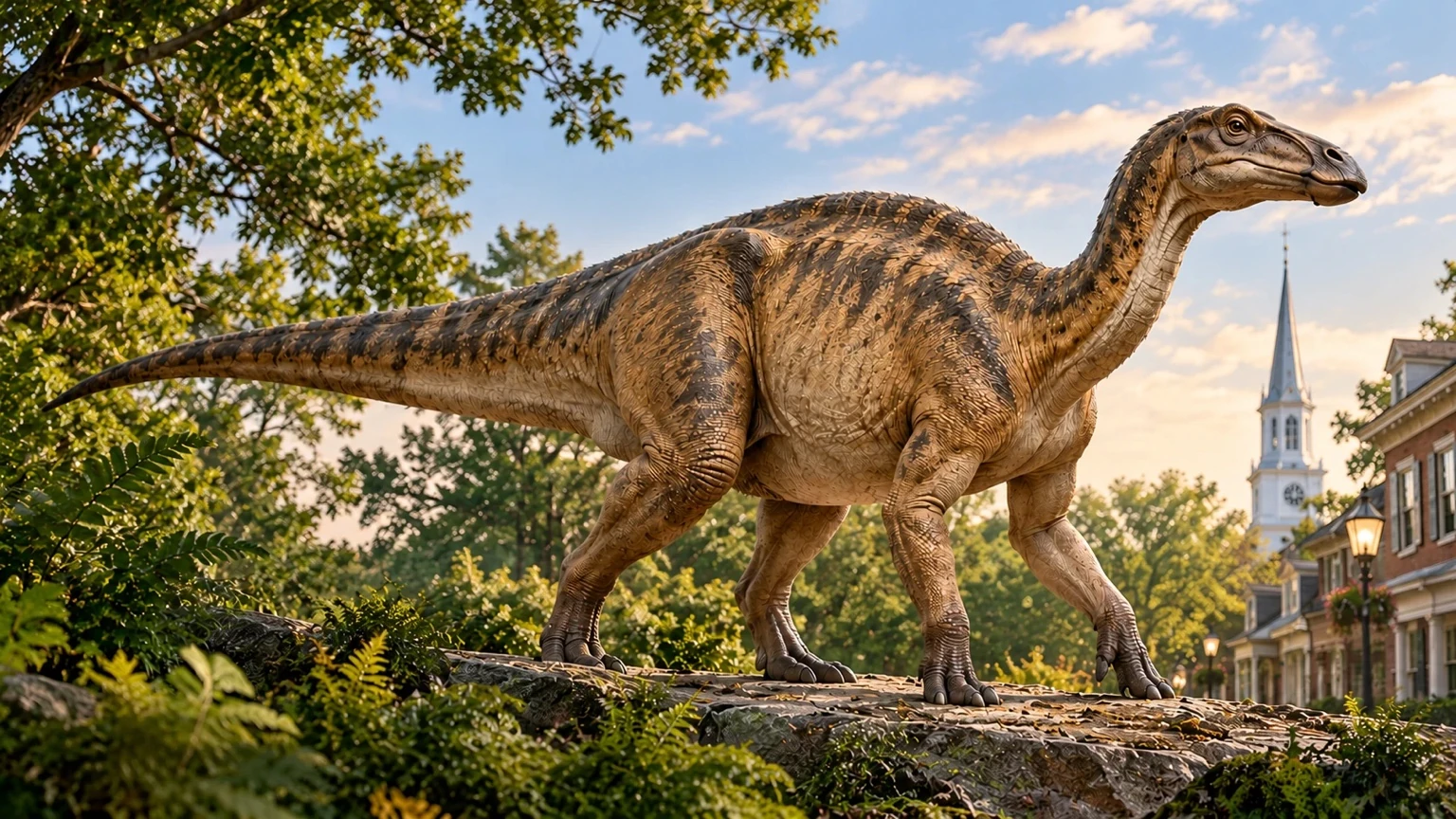
The Haddonfield material included substantial limb bones and vertebrae, along with teeth and parts of the jaws. The skull was incomplete. Leidy recognized a dinosaur and named it Hadrosaurus foulkii, honoring Foulke.
The difference between the forelimbs and hind limbs mattered. Leidy considered whether the animal could support itself on its powerful back legs. The discovery helped challenge familiar images of dinosaurs as uniformly low, sprawling animals. It was evidence that scientists could compare, measure and debate, rather than a complete answer to every question about the animal.
A skeleton in public
In 1868, Benjamin Waterhouse Hawkins assembled a mounted reconstruction for the Academy of Natural Sciences in Philadelphia. Fossils from Haddonfield had helped make it possible to present a dinosaur as a full skeleton to the public. A mount was also an interpretation: missing parts had to be reconstructed.
That distinction still matters. Original fossil bones, casts of those bones, complete museum mounts and pictures of a living dinosaur are different things. Each can help explain the story, but they do not all provide the same kind of evidence.
What the site means today
The National Park Service nomination documents the discovery locality near the small stream and the commemorative area. The memorial and the exact excavation locality are not interchangeable. A modern visit should follow marked access and respect the ravine; it is not an invitation to dig or collect.
For this project, the story does not end with the excavation. You can keep exploring the animal, the downtown bronze Haddy and the town around them here on HaddyDino. The source notes below explain where the historical facts came from. You do not have to leave this page to read the story.
Sources & research notes
Original HaddyDino writing based on the sources below. These optional links open separately.