The artist who stood a dinosaur upright
In 1868, English sculptor Benjamin Waterhouse Hawkins turned Haddonfield's fossil bones into the first mounted dinosaur skeleton the world had ever seen.
HaddyDino editorial voice · Researched introduction · October 14, 2026. This is not an eyewitness memoir.
Dinosaurs in plaster, first
Benjamin Waterhouse Hawkins (1807–1894) was an English sculptor and natural history artist who had already changed how the public imagined prehistoric life once before. In the early 1850s, the Crystal Palace company commissioned him to build 33 life-size concrete models of extinct animals for the great glass palace's new park at Sydenham, in south London. Working under the scientific direction of Sir Richard Owen, Hawkins gave Victorian families something no book could: extinct giants they could walk around.
The project produced one of the most famous dinner parties in science. On New Year's Eve 1853, Owen hosted a meal inside the mould used to build the Iguanodon model. The finished sculptures still stand in Crystal Palace Park today. But plaster and concrete giants in a park were only a beginning. Hawkins' boldest act was still to come, and it would happen with real fossil bones — in Philadelphia.
A skeleton rises in Philadelphia
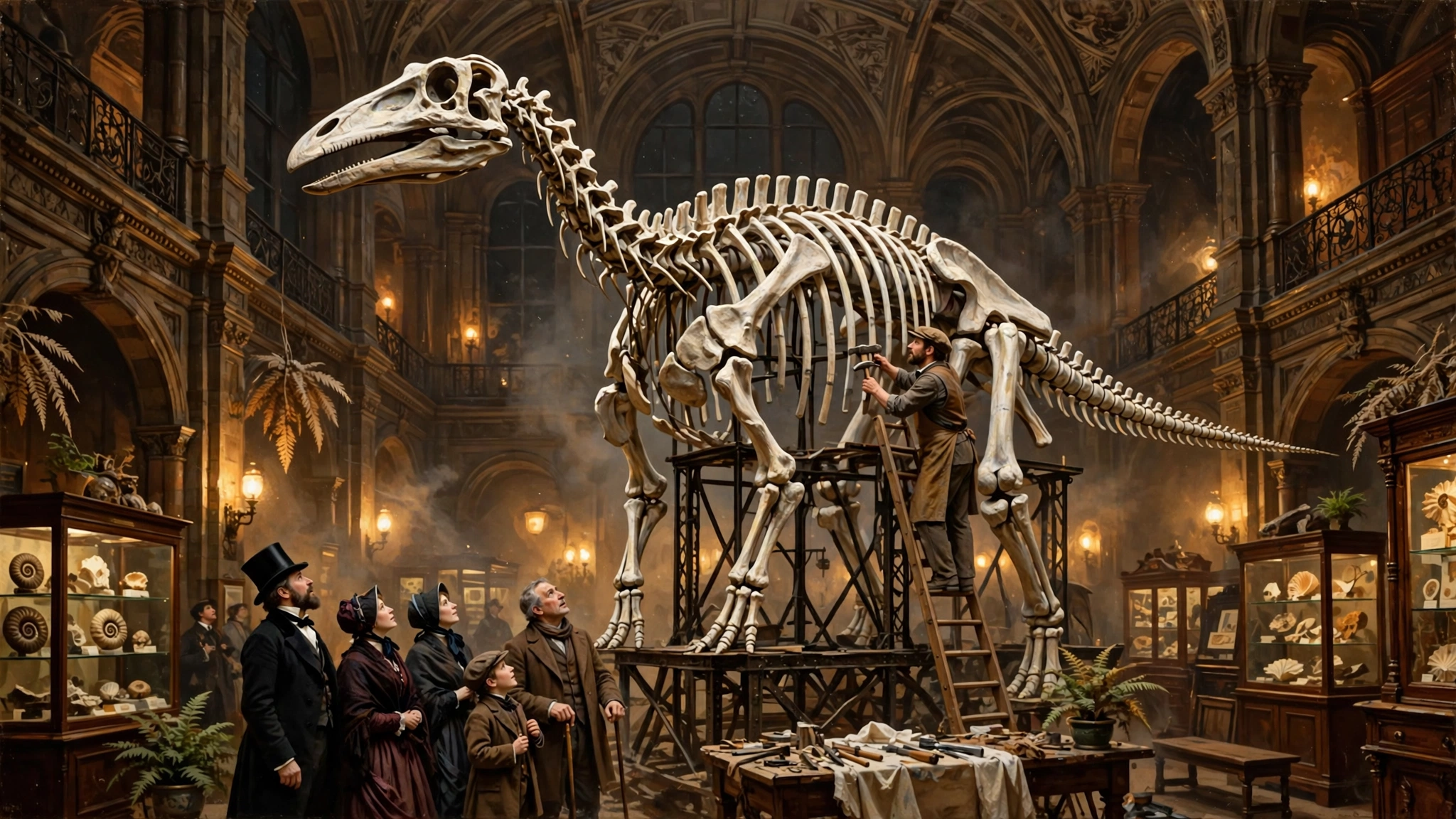
In 1868 Hawkins crossed the Atlantic to deliver lectures in the United States. At the Academy of Natural Sciences in Philadelphia, he found a challenge no artist had ever attempted: the fossil bones of Hadrosaurus foulkii, excavated ten years earlier in a Haddonfield marl pit. Working closely with Joseph Leidy, the scientist who had named the animal, Hawkins designed and cast an almost complete skeleton, joining the genuine fossil bones with plaster reconstructions of the parts that were missing.
The finished skeleton was supported on an iron framework in a lifelike, upright pose at the Academy's museum, then located at Broad and Sansom streets. Nothing like it had ever been displayed anywhere: it was the world's first mounted dinosaur skeleton. When a version of the restored skeleton was unveiled at a lecture in New York, hidden behind curtains until the dramatic moment, one reporter wrote that the audience was taken completely by surprise at the sight of the 25-foot restored animal.
The exhibit that filled a museum
The Philadelphia exhibit was an instant sensation, drawing visitors from far beyond the city. Estimates suggest the Hadrosaurus increased the Academy's attendance by as much as 50 percent, and it remains one of the most popular exhibits in the institution's history. The Academy became known as "the dinosaur museum," and the crowds of the post–Civil War years helped launch the public's lasting fascination with dinosaurs.
It is worth pausing on what a mount really is. The 1868 Hadrosaurus was both evidence and interpretation at once: real bones from Haddonfield, plaster standing in where the skeleton was incomplete, and a posture that embodied Leidy's reading of the anatomy. That honesty matters to us at HaddyDino. A fossil bone, a cast of that bone and a life-size reconstruction are three different things, and each tells a different kind of truth.
A lost museum, a lasting idea
Success in Philadelphia brought Hawkins a grander commission: a Palaeozoic Museum for New York's Central Park, filled with life-size restorations of America's prehistoric animals. He built several of the models in a New York studio. But by 1871 the project had collapsed in scandal — the models were smashed by men working for the corrupt politician William "Boss" Tweed, and the museum was never built. Hawkins eventually returned to England, where he died in 1894.
The idea he proved in 1868 survived the wreckage. The original Haddonfield bones remain in the Academy's care, and casts of Haddy have stood in its halls across the decades. Every dinosaur skeleton towering over a museum gallery today descends from the experiment Hawkins and Leidy made together: that a box of broken fossils, honestly reconstructed, could stand up and change what the public believed was possible. To see how the bones reached Philadelphia in the first place, start with the discovery that changed the picture.
Sources & research notes
Original HaddyDino writing based on the sources below. These optional links open separately.