The professor who read the bones
In 1858, Philadelphia professor Joseph Leidy gave Haddy its scientific name — and, reading a pile of Haddonfield fossils, dared to stand a dinosaur on two legs.
HaddyDino editorial voice · Researched introduction · October 14, 2026. This is not an eyewitness memoir.
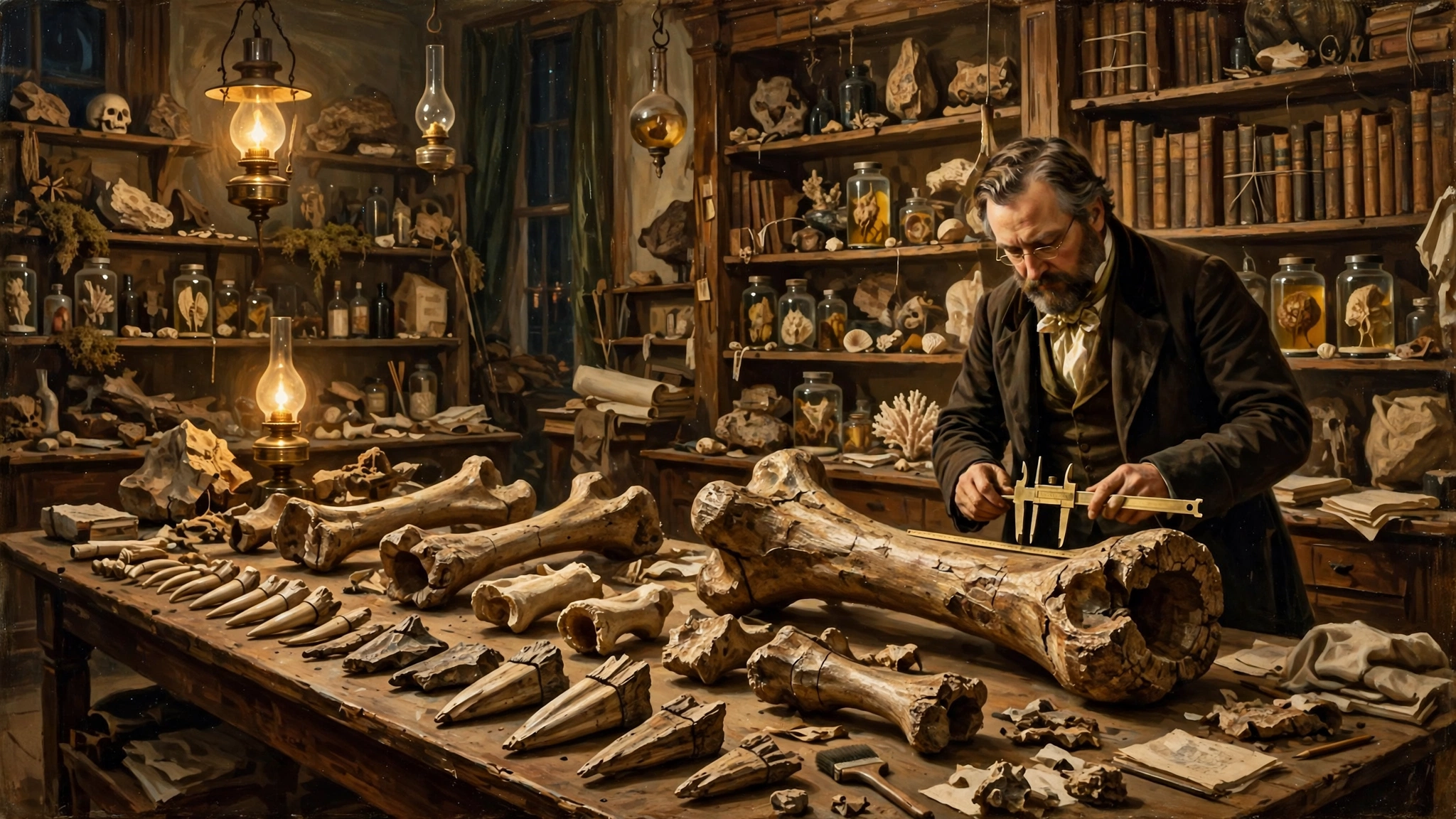
A mind for every specimen
Joseph Leidy (1823–1891) was Philadelphia's indispensable scientist. A professor of anatomy at the University of Pennsylvania and a central figure at the Academy of Natural Sciences, he seemed able to read any specimen placed in front of him: fossil bones, parasites, freshwater creatures, blood under a microscope. At a time when science was often the hobby of wealthy amateurs, Leidy made it a profession built on careful observation.
His range was extraordinary. In 1846 he reportedly used a microscope to examine blood found on a farmer's axe and showed that it was human blood, not chicken blood as the man claimed — an early landmark in forensic science, and one of many firsts in a career that helped found American parasitology and microscopy. When strange bones arrived from a marl pit across the river in New Jersey, there was really only one man to send them to.
Naming Haddy
The bones came from William Parker Foulke's 1858 excavation on the Hopkins property in Haddonfield. Spread before Leidy was an assemblage no scientist had ever been given for a dinosaur: an almost complete set of limbs, a pelvis, parts of the feet, twenty-eight vertebrae — eighteen of them from the tail — eight teeth and two small pieces of jaw. The skull was incomplete, but the skeleton was far more complete than anything known from Europe.
Leidy recognized a relative of England's Iguanodon, but a distinct animal. In 1858 he formally described and named it Hadrosaurus foulkii — Hadrosaurus, roughly "bulky lizard" from the Greek, and foulkii in honor of Foulke, whose labor had recovered it. It was the first nearly complete dinosaur skeleton known to science, and the name Leidy coined that year is the name it still carries.
Standing the dinosaur up
Leidy's boldest insight came from proportion. The hind limbs of the Haddonfield animal were far larger and stronger than its forelimbs. Against the prevailing view of dinosaurs as heavy, sprawling quadrupeds, Leidy concluded that this animal could adopt a bipedal posture — rearing up on its hind legs, rather as a kangaroo does. Like many of his contemporaries he also imagined the creature at home in the water; interpretations evolve, and honesty about that is part of the science. But the two-legged idea was his, and it was revolutionary.
Leidy set out his reasoning in a fuller monograph, Cretaceous Reptiles of the United States. He wrote it in 1860, but the American Civil War delayed its publication until 1865. When the Academy decided to mount the skeleton for the public a few years later, it was Leidy's anatomy that guided the artist's hands — the story told in the artist who stood a dinosaur upright.
The quiet giant steps back
Haddy was only the beginning of Leidy's fossil legacy. He described the dire wolf, the American lion and the giant short-faced bear, among many others, and his Extinct Fauna of Dakota and Nebraska (1869) opened the American West to paleontology. He was also an early American supporter of Charles Darwin's theory of evolution, and successfully lobbied for Darwin's election to membership in the Academy of Natural Sciences. In 1884 he received the Lyell Medal, one of geology's highest honors.
Yet the field he founded grew rough. His own student Edward Drinker Cope fell into a ruthless rivalry with Othniel Charles Marsh — the famous "Bone Wars" — and the feud helped drive the quieter Leidy out of western vertebrate paleontology altogether. He died in Philadelphia in 1891. What he left behind is embedded in this town's story: a name given in 1858 that is still in use, and a way of reading bones — patiently, comparatively, honestly — that began with a pile of fossils from a Haddonfield hillside. Return to the discovery that changed the picture to see where those bones came from.
Sources & research notes
Original HaddyDino writing based on the sources below. These optional links open separately.