Late Cretaceous. Source: Academy, 2025.
Home / The Haddy Evidence Lab
HADDYDINO / EXPLORE WITH EVIDENCE
The Haddy Evidence Lab
Compare size, explore the bones and inspect the historical documents.
01 / THE ANIMAL AT A GLANCE
How big was Haddy?
The animal lived in coastal New Jersey. Source: Academy, 2025.
Estimated body length, not a measurement of a complete fossil. Source: NJ Geological Survey, about 25 ft.
02 / READ THE BONES
What was found—and what was filled in?
Open a region to connect the evidence with the limits of a reconstruction. This teaching diagram groups broad regions; it is not an inventory of individual preserved bones.
Schematic only. Dashed head: a full skull was not recovered.
1 · Head and teeth
Jaw fragments and teeth are evidence; a complete skull was missing. A full museum head therefore includes reconstruction.
2 · Backbone
Vertebrae were among the recovered remains. A full mounted spine should not be read as a complete original fossil.
3 · Forelimbs
Limb bones helped Leidy compare the front and back of the animal. Modeled missing parts belong to a reconstruction.
4 · Hindlimbs
The femur is a thigh bone. Open Leidy’s 1865 plate below to inspect several views of this bone.
Bone descriptions and original publications: Linda Hall Library ↗ · Original fossils and mount: Academy ↗
03 / LOOK AT THE DOCUMENT
Evidence you can inspect
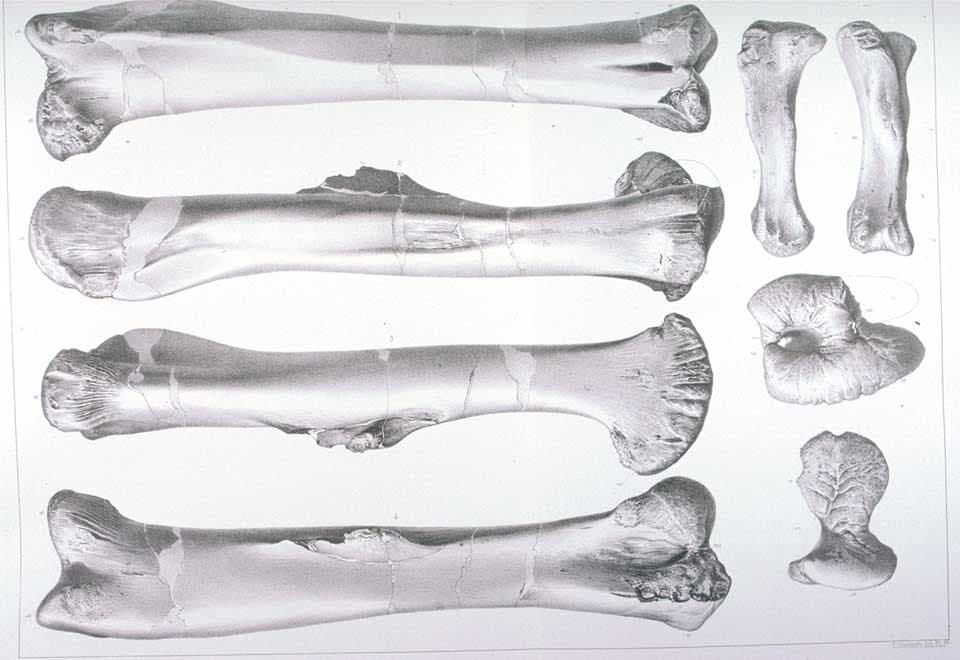
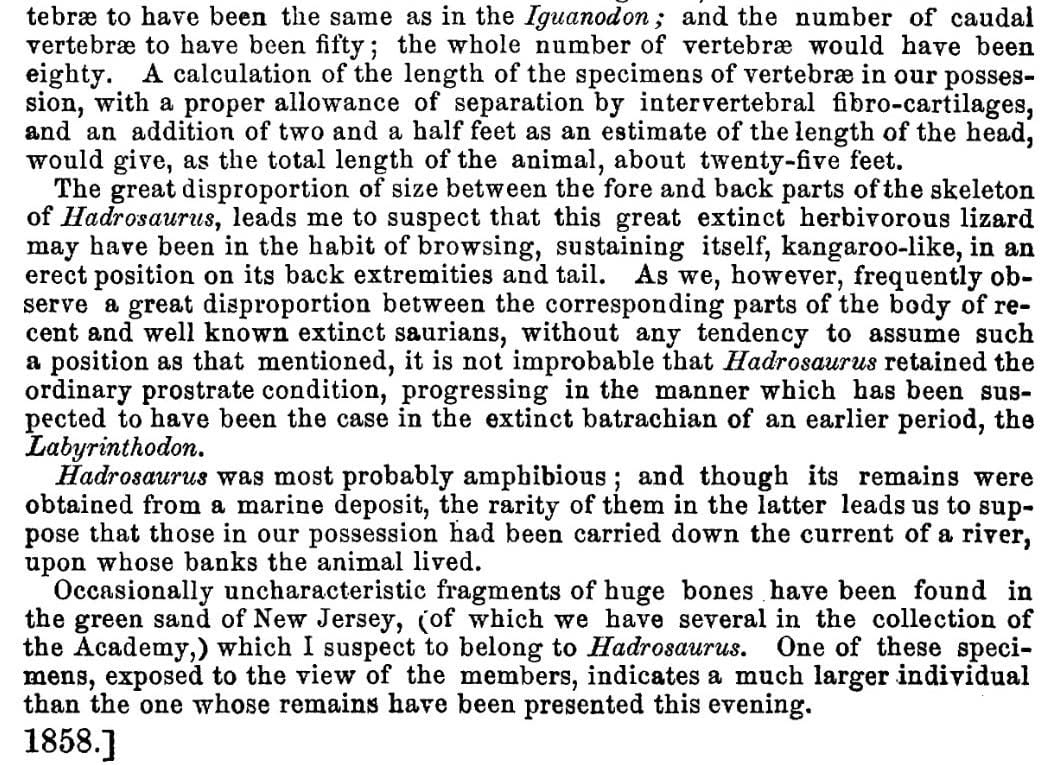
Original publications from 1858 and 1865 are in the U.S. public domain by age. Digital reproductions from Linda Hall Library; open its catalog for full context. The image files are served from this website.
Read provenance and catalog records ↗
Why do some sources say 1859?
Linda Hall identifies remarks published in 1858, while the Academy’s 2025 release gives 1859 for the first description. The linked 1858 page is documentary evidence to inspect; the later release does not explain its different date.
Sources checked October 26, 2026. Visitor conditions can change.